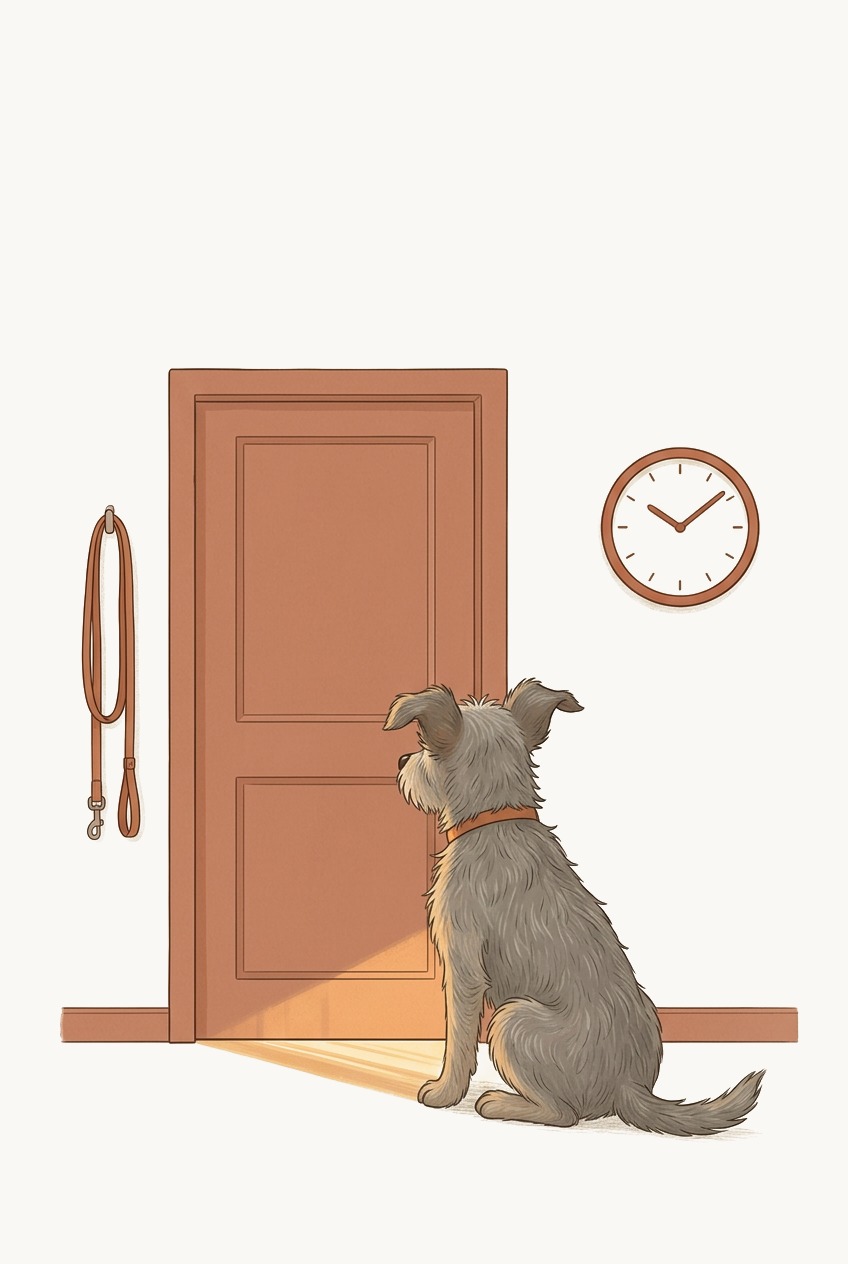
Dogs can't read a clock, and yet many of them know when dinner is. They are at the door before the school bus turns onto the street. They are waiting by the bowl at five o'clock on days when nobody has said a word about it. Some seem to know the difference between a school day and a Saturday without being told.
Researchers haven't found one explanation. What the evidence points to is several clocks running at once: one inside the dog, one in the smell of the house, and one in the dog's remarkably close study of you. The last may be the most interesting.
The clock inside
Like people, dogs have a circadian rhythm, a roughly 24-hour internal cycle that helps regulate sleep, waking and hunger. VCA Animal Hospitals notes that dogs seem to perceive time through changes in their bodies, their surroundings and their routines. A study of dogs of different ages found that every dog showed a clear daily rhythm, and that how often the dogs were fed changed the shape of that rhythm, including how active they were in the hour before morning light.
Meals seem to be especially good at setting the clock. In a laboratory experiment described in Modern Dog magazine, dogs were given meat powder at noon every day for two weeks while researchers measured their saliva. On the fifteenth day the powder never came, and the dogs still began to salivate at almost exactly noon.
The best-studied version of this comes from rats and mice, which grow more active in the hours before a regular meal, in a pattern that behaves like a clock of about 24 hours. Dogs have been studied less closely, but a dog waiting at the bowl at five o'clock is consistent with the same thing.
A body clock has a limit, though. It can tell your dog that it is roughly dinnertime. It cannot tell your dog that today is a school day, or that you are about to leave, or that the person in the driveway is the one who lives here. For that, a dog needs to be watching.
The great watchers
Dogs pay attention to people in a way that is unusual in the animal world, and it has been tested.
In a 2003 study in the Journal of Comparative Psychology, researchers forbade twelve dogs from taking a piece of visible food, then changed what the person was doing. Sometimes the person watched the dog throughout. Sometimes she left the room, turned away, was busy with something else, or closed her eyes. When she was watching, the dogs took less food, approached it more indirectly, and sat more often instead of lying down. When she wasn't, they behaved differently. Dogs, in other words, keep track of whether you are paying attention to them, down to whether your eyes are open.
The Max Planck Institute for Evolutionary Anthropology in Leipzig has spent years on this question, and its overview of the work describes dogs choosing the container a person points to when food is hidden. Puppies between six and sixteen weeks old did it too, which suggests the skill is largely inborn rather than learned. Hand-reared wolves reportedly did not understand pointing, and chimpanzees failed similar tests. In another test, dogs more often fetched the toy that the person could see, which the researchers took as a sign of some understanding of what a person perceives, though not as conclusive proof.
Hold that picture beside your own day. You don't announce that you're leaving. But you put on your shoes, pick up the bag, check your pockets, glance at your phone, take a breath at the door. Rover's overview describes dogs picking up on exactly this kind of context, such as you reaching for your car keys or opening a particular cabinet, and combining it with things like the amount of daylight and certain scents. A dog who watches faces, hands and eyes this well is a dog who has read your whole morning routine long before you notice you have one.
That also explains the school bus. The sequence is rarely one cue. It is the light going gold in the window, the neighbor's car, the afternoon quiet, the particular time your own routine shifts to the kitchen. Dogs seem to stack small clues, and a day with a familiar shape gives them plenty to stack.
They can smell what you are feeling
Dogs also read us through a sense we barely have. A 2022 study from Queen's University Belfast, published in PLOS ONE, collected breath and sweat samples from 36 people before and after a fast-paced arithmetic task, using only samples from people who reported more stress and showed a higher heart rate and blood pressure. Four trained dogs then had to pick out each person's stressed sample from a lineup that also held that person's calm one. They chose correctly in 675 of 720 trials, about 94 percent of the time.
The study shows that dogs can smell the difference. It does not show what dogs do with that information at home, and I'm not aware of any study that tests whether a dog uses it to predict a departure. But it would be reasonable to wonder. The rushed morning, the tense phone call, the half-hour of low-grade dread before leaving the house all have a smell, and the dog is in the room for every minute of it. That part is speculation, not a finding.
They may smell the hours pass
The most striking idea about dogs and time comes from Alexandra Horowitz, who studies dog cognition at Barnard College. Her suggestion is that dogs track time by smell. A person leaves a scent signature all through a home, and once they leave, it weakens. A dog with a nose that sensitive could notice how faint it has become.
NPR told the story of Donut, a family dog who would get up and wait at the door shortly before the school bus brought the boys home, every school day. Horowitz said she wasn't at all surprised. The two brothers were away from the house for about the same stretch of time each day, so their scent in the rooms would drop to roughly the same level just before the bus arrived. Donut may have been reading that level. Horowitz also points to dogs trained to find missing people, who follow a trail through changes in the scent along it, and so track time as they track space.
She is quick to say this is only a hypothesis, and Stanley Coren, writing in Psychology Today, agrees that no systematic study has tested it. It fits how dogs live, in a world organized by smell, but it is an idea to hold loosely. It is also a beautiful one: a house where the person you love is a fading trace in the air, and the dog knows when it has faded to the right level.
How long is long?
Whether a dog can sense how long you have been gone is a separate question. In a 2011 study, researchers left twelve dogs with no history of separation problems alone at home for thirty minutes, two hours and four hours, and recorded how each greeted its owner on return. The dogs greeted more intensely after two hours and after four than after thirty minutes. There was no significant difference between two hours and four.
The authors were careful about what that shows. The study can't say whether the dogs knew how long they had been alone, or only noticed once their person walked back in. So the evidence supports a dog who can tell a short absence from a long one. It doesn't yet show a dog counting the hours.
When the clocks change
Dogs follow their own rhythms and the shape of your day, not the number on the wall, so a clock change can leave them a little out of step. Veterinarian Dr. Sara Ochoa says, in an article for The Honest Kitchen, that most pets do notice the change, especially in the fall. If your dog seems unsettled, the usual advice is to shift meals, walks and bedtime by about fifteen minutes a day over several days. Most pets settle within a few days to a week.
What the dog at the door knows
So how do dogs tell time? Obviously not by counting. They seem to do it by noticing: a body that remembers when it is usually fed, a nose that registers a house gradually emptying of you, and an attention so steady that it catches the keys, the shoes, the light and the quiet, and knits them into a prediction.
None of this asks a dog to understand the hour. It asks only that our days have a shape, and the dogs who live with us learn it, one small cue at a time.
For more on how dogs read the world, browse Breeds & Behaviour, or find the stories that bring the science to life in the best dog books.