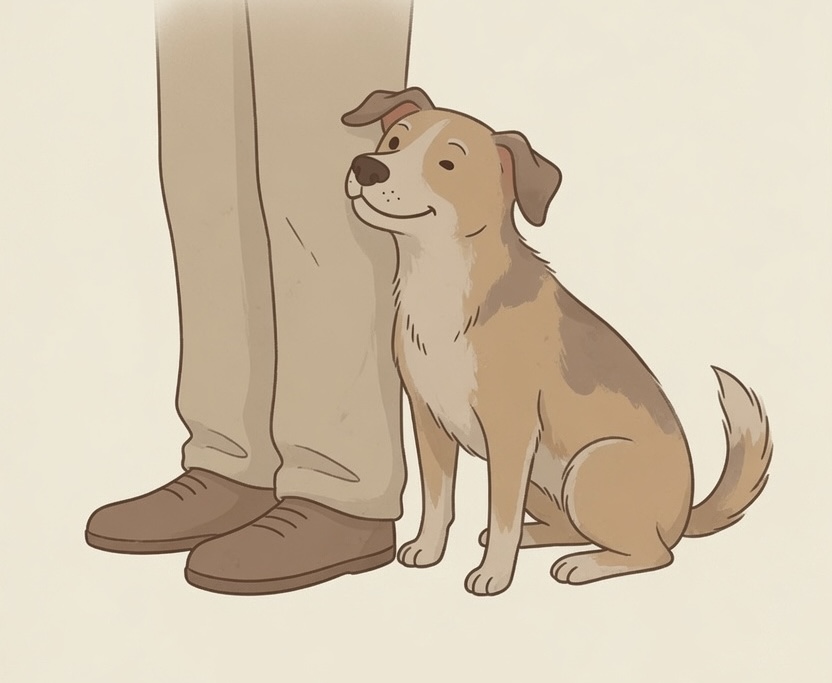
You're standing at the kitchen counter when a warm weight settles against the back of your legs. No barking, no pawing, no demand — just the quiet press of a dog who has decided the best place in the house is wherever you happen to be. If you've ever wondered why your dog leans on you, the short answer is also the loveliest one: it's trust. The lean is a dog's version of a hug.
The lean is usually love
Dogs are physical in a way most of us have forgotten how to be. They sleep in piles, press into one another, and measure closeness in shared surface area. Leaning is part of that same vocabulary — what behaviorists call affiliative behavior, the instinct to be near the ones you belong to. For a big dog who can't fold into your lap, leaning is simply how the lap problem gets solved. Most of the time, your dog leans because being near you feels good, and being against you feels better.
No, your dog isn't trying to dominate you
You'll still find corners of the internet insisting that a leaning dog is "claiming territory" or "asserting dominance." It's a stubborn myth, and a tired one. The whole idea comes from outdated wolf-pack theory that behaviorists have spent decades taking apart. A dog pressing its shoulder into your shin is not staging a quiet coup. It's asking to be close, which is a far simpler and far kinder thing.
Sometimes the lean is a question
Affection and reassurance can look almost identical from the outside, so context is everything. A dog that leans hard at the vet, on a walk past a barking stranger, or during a thunderstorm is saying something nearer to please stay close. Read the rest of the body. Soft eyes and a loose, easy posture mean contentment; a tucked tail, flattened ears, lip-licking, or a stiff frame mean your dog is borrowing your steadiness. In those moments, the kindest answer is just to be the steady thing.
When leaning is worth a second look
Now and then, leaning is physical rather than emotional. A dog that suddenly leans for balance — unsteady on its feet, tilting, or pressing its head against walls and furniture — is a different matter, and worth a call to your vet. And constant, anxious clinging that tips into distress when you leave can point to separation anxiety. The everyday lean against your legs while you make coffee is none of these things. But it's worth knowing the difference.
The great leaners
Some dogs lean more than others. Great Danes are famous for it — the "Great Dane lean," delivered at full weight as though gravity were a love language. Greyhounds, mastiffs, boxers, and the velcro herding breeds tend to be devoted leaners too, often simply because they're too large to be lapdogs and have improvised accordingly. And plenty of dogs never lean at all, which says nothing about how much they love you. Affection has dialects.
A book that changed how I read my own dogs
If you want to go deeper than a single gesture, the writer who taught me to actually read what my dogs were saying is the animal behaviorist Patricia McConnell. Her book The Other End of the Leash is that rare thing — science-grounded and a genuine pleasure to read. It quietly reframes most of what we get wrong about dogs, leaning included.
The lean is one small entry in a much larger vocabulary: the wordless, daily ways dogs tell us we're theirs. It's the thing I find myself writing about over and over. If you love that bond as much as the leaning suggests your dog does, you might wander over to my list of the best dog books — or, fair warning, it's a soft spot of mine, The Goodest Boy, ten stories about exactly this kind of quiet devotion.
And if you want more of the funny, baffling little things our dogs get up to, here's why does my dog do that, or why dogs love sticks.
And for more like this — warm, useful, dog-obsessed — my newsletter The Goodest Place is where it all lands first.
The Goodest Books is a participant in the Amazon Associates Program. As an Amazon Associate we earn from qualifying purchases — some links above are affiliate links, and buying through them helps us keep writing dog stories at no extra cost to you.