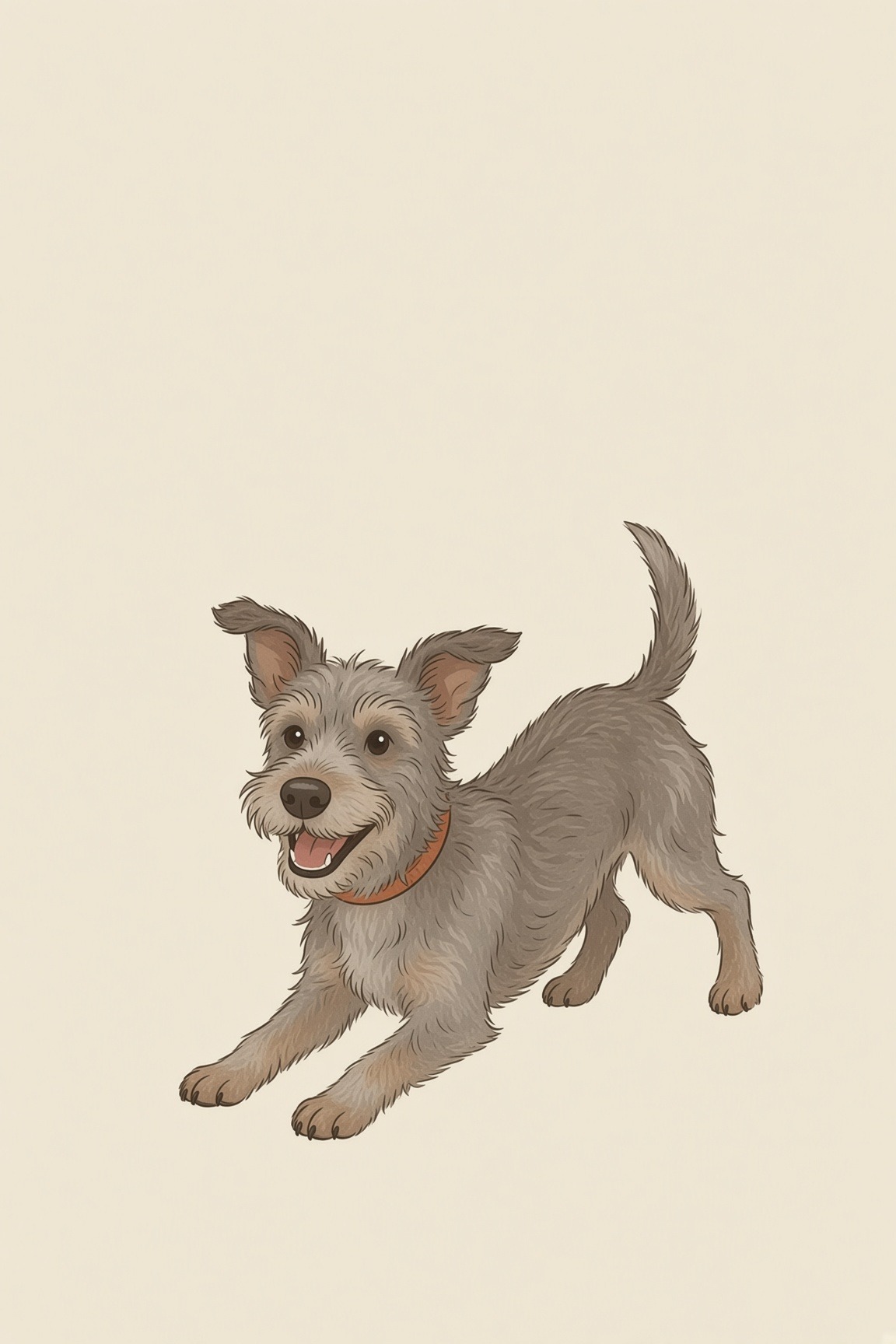
If you've ever wrestled with your dog on the floor and heard a breathy, rhythmic "hhuh, hhuh" that isn't quite panting and isn't quite a bark, that's not your imagination. There's real research behind it, and it's a little more interesting than "dogs are happy, therefore laughing."
The Goodest Books is a participant in the Amazon Associates Program. As an Amazon Associate we earn from qualifying purchases — one link below is an affiliate link, and buying through it helps us keep writing dog stories at no extra cost to you.
The sound has a name, and it's been studied
In the early 2000s, researcher Patricia Simonet stood in parks with a parabolic microphone and recorded dogs mid-play. When she ran the recordings through a spectrogram, the "play pant" turned out to be acoustically different from ordinary panting. It was a forced exhalation spread across a broader range of frequencies, not just heavy breathing. She called it, informally, "dog laughter".
It wasn't just a fun label. Simonet played the recorded sound back to a group of puppies, and they responded by playing more! The sound itself seemed to invite play, not just accompany it.
It's older than that research, too
It's a social sound, not a private one
So, do dogs laugh?
But is it actually amusement, or is it an invitation?
Here's the honest distinction worth sitting with: everything above describes a signal, not necessarily a feeling. In 2021, UCLA researchers Sasha Winkler and Greg Bryant reviewed the scientific literature on play behavior across species and found something similar to the dog play-pant in at least 65 animals: parrots, foxes, seals, chimpanzees, even cows. Its job, in every case, seems to be the same: to say, unambiguously, this is play, not a real fight. Winkler put it plainly: the whole point is to disambiguate rough tumbling from an actual bite to the neck.
That's a genuinely useful thing for a sound to do. It's also a different thing from finding something funny. Human laughter shows up in response to humor and irony, not just physical roughhousing. We laugh at a well-timed joke with nobody touching us at all. There's no evidence dogs do anything comparable. Most researchers studying this are careful not to claim otherwise; the play-pant looks like laughter, functions a little like laughter, but almost certainly isn't accompanied by the same "I get the joke" cognitive spark that makes human laughter what it is.
So what you're actually hearing, next time your dog huffs that breathy little pant mid-game, is closer to an exclamation point than a punchline. A clear, physical this is fun, keep going rather than genuine amusement at something clever or absurd. Which, honestly, might be the better version. No joke required. Just two creatures agreeing, in real time, that this is good fun.
For more on what dogs are telling us, see whether dogs really love us and why they do that.
And for more like this (warm, useful, dog-obsessed), visit my newsletter The Goodest Place is where it all lands first.