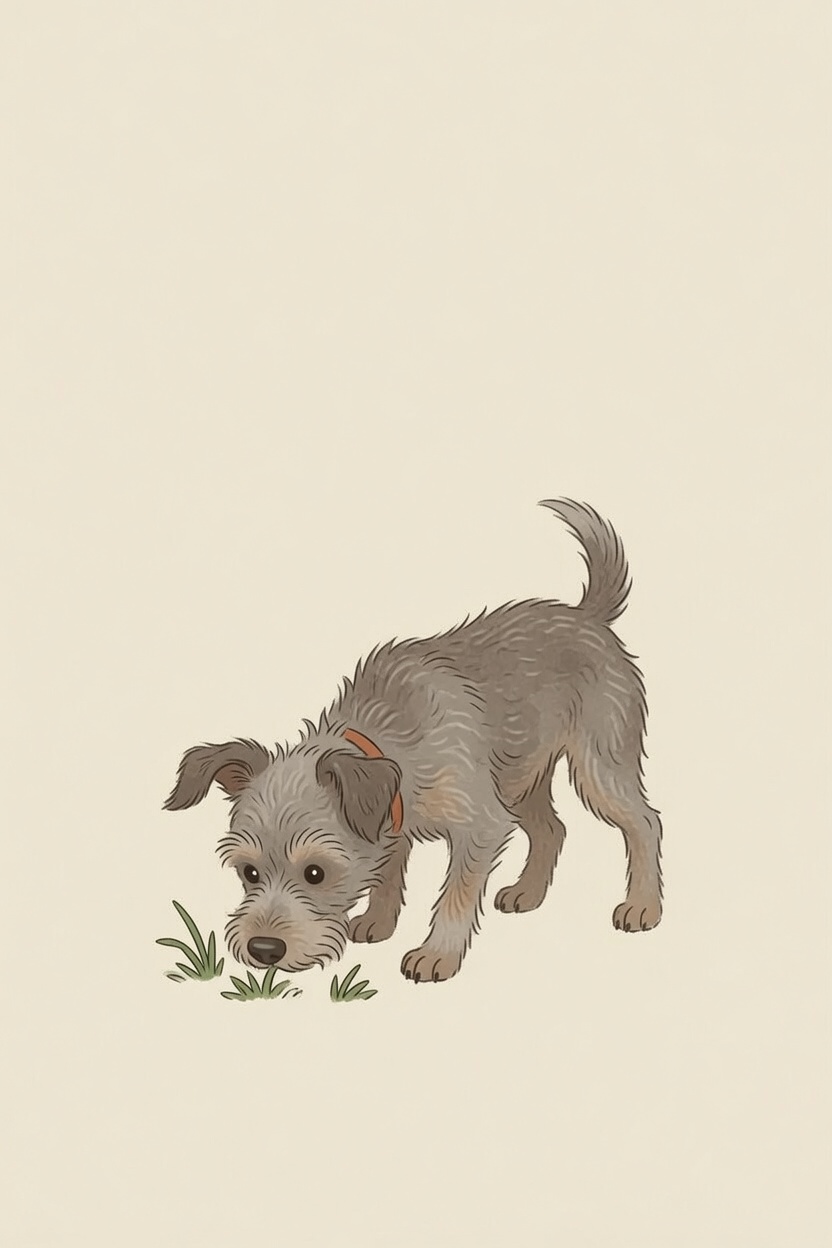
Mocca is a connoisseur of places to pee, and she wants me to know it. A walk with her is less a walk than a slow curatorial process. She will investigate a tuft of grass at length, consider it, and move on unimpressed. A fence post gets a longer appraisal, promising but not quite. Then some entirely unremarkable clump of weeds, indistinguishable to me from the forty she has already rejected, stops her cold. This one. This one is worthy. And only after all that deliberation, all that sniffing and weighing and judging, does she finally, ceremonially, commit.
For years I assumed this was simple fussiness, a dog being needlessly particular while I stood there holding the leash and losing the light. It turns out I had it backwards. She is not being fussy. She is doing something genuinely sophisticated, and once you understand what, the waiting becomes a great deal more interesting.
She is reading before she writes
A spot of ground where dogs pee is not just a spot of ground. It is a message board. When your dog puts its nose down and inhales at length, it is reading, decoding a dense stack of information left behind in other dogs' urine. And there is a startling amount in there. Researchers describe canine urine marks as carrying signals about a dog's identity, sex, reproductive status, health, stress level, and social standing (Lisberg and Snowdon, 2011, Animal Behaviour). One recent study went further, measuring the hormones and neurotransmitters bound up in marking behaviour and confirming that a dog's emotional and physiological state is written into the message itself (a 2025 study in Scientific Reports). What reads to us as a blank patch of grass is, to your dog, a page of news.
So the long sniff is not hesitation. It is reading the whole page before deciding what to say back.
And what is she actually saying?
This is the part the usual explanations get wrong. We tend to reach for the word "territorial," as though every dog is simply shouting keep out. The science tells a subtler story. Marking is less a fence and more a social profile, a way of announcing who I am, how I am, and whether I am available, left in a form other dogs can read safely, from a distance, without the risk of a face-to-face meeting. One researcher, Dr. Anneke Lisberg, memorably called scent marking the canine equivalent of a social network: dogs sorting out much of their relationship with one another through marks, long before they ever meet nose to nose.
So when Mocca finally commits to a spot, she is not so much claiming ground as posting an update. Here I am. This is my status. This is my news. It is communication far more than conquest.
Deciding whether to answer, and how
Once a dog has read the messages, it decides whether to reply, and this is the deliberation you are watching. Not every mark warrants a response. But when a dog finds one worth answering, it may pee directly over it, a behaviour called overmarking, or just beside it, called adjacent marking. And crucially, who does this is not random.
Studies of marking behaviour found that overmarking, laying your message directly on top of another dog's, is done most by dogs of higher social status and confidence, while lower-status dogs are far more cautious about it (Lisberg and Snowdon, 2011). It is, in fact, risky for a timid dog to overmark a confident one; it is a little like talking back to someone above your station, and the higher-ranking dog can tell. There are patterns of place, too. One study of free-ranging dogs found males more likely to overmark at the edges of their territory and females more likely to mark near their dens, which suggests marking is tangled up with resources, mating, and status all at once, not just territory (Pal, 2003, Applied Animal Behaviour Science).
So Mocca rejecting forty spots and choosing the forty-first is not fussiness. It is editorial judgment. Most of those spots simply were not worth a reply. The one she chose was, because of who had been there and what she wanted to say in return, and perhaps because she was confident enough to say it.
She is keeping a map in her head
A stranger reason, while we are here
One odder note worth mentioning. There is genuine research suggesting dogs may orient to the Earth's magnetic field when they position themselves to eliminate, aligning roughly north to south (Hart et al., 2013, Frontiers in Zoology). It is not fully settled, and it applies to calm conditions in a stable magnetic field, but it is a real and delightful finding: some of that circling and adjusting may be a kind of internal compass at work, your dog quietly lining itself up with the planet before it commits.
And the least mystical explanation of all, often the truest: some dogs sniff for a very long time simply because they have worked out that finishing means going back inside. The extended survey is, at least partly, a stalling tactic, a way to stretch the best part of the day out a little longer. I cannot prove Mocca does this. But I have my suspicions.
So the next time you are standing there waiting
It is worth reframing the whole thing. When your dog takes an age to choose a spot, it is not being difficult, and it is not wasting your time on purpose, mostly. It is reading the messages, weighing whether to answer, updating its map of the world, and choosing exactly where to leave its own so the right dogs will find it. It is the most information-rich moment of the entire walk.
So I have mostly stopped hurrying Mocca through her deliberations. She is not being slow. She is being thorough. And the least I can do, while she reads the neighbourhood news and decides on her reply, is stand there and hold the leash, and try to enjoy the view while I wait.
For more on the quiet things dogs do, see why your dog leans on you or why dogs love sticks so much. And if you love a good dog story, here are the best dog books.
And for more like this — warm, useful, dog-obsessed — my newsletter The Goodest Place is where it all lands first.